DOYLESTOWN REPAIR SERVICE

Boiler Diagnosis & Repair in Doylestown, PA

A Doylestown boiler that runs but misbehaves — short-cycling, losing pressure, banging on startup, cold rooms in a stone house — needs diagnosis, not parts roulette. This page covers how local pros test a system before touching it, the repair calls that recur in the borough's oldest housing, and where repair stops and replacement starts.

✓ Diagnosis before parts✓ Gas, oil & steam systems✓ a phone conversation about symptoms

General inquiries: 7 AM–7 PM · Emergency calls: 24/7 · (888) 766-1474

Repair or replace?

The honest framing, before anyone sells you anything.

Doylestown has some of the oldest heating systems in the region — and old is not the same as done. Cast-iron blocks routinely last decades; the borough's stone colonials often heat on boilers older than their owners. Most recurring faults live in the replaceable parts around the block: nozzles, electrodes, and filters on oil burners; thermocouples and gas valves on atmospheric units; feed valves and expansion tanks on sealed systems. Those are repairs, and good ones.

Replacement becomes the honest answer when the block itself is weeping from sections, when a farmhouse oil tank is failing (which tips the whole math), or when a gravity or steam relic has been patched past the point of sense. If that is where your system sits, the replacement page walks through sizing for stone-mass housing — where the house, not the old nameplate, sets the size.

Boiler Repair in Doylestown, PA

How Doylestown boiler diagnosis works

Testing before parts.

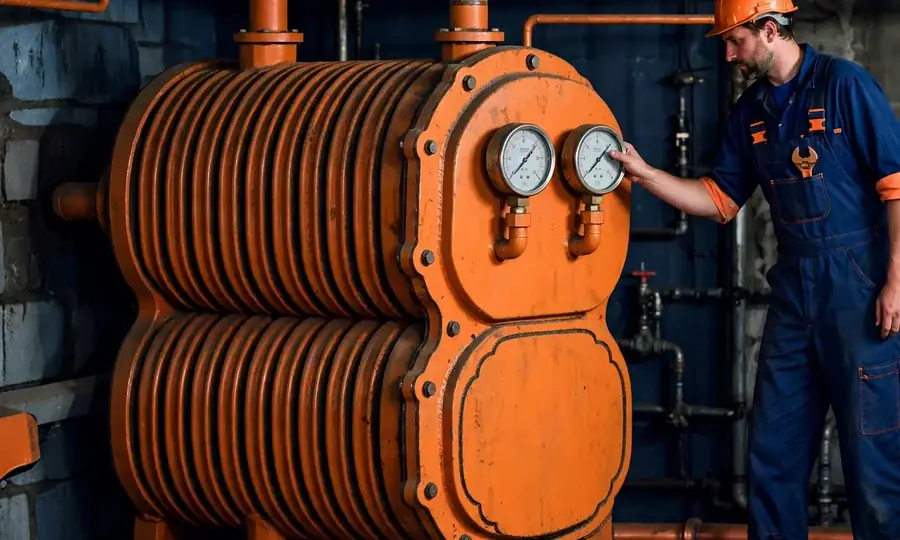
A proper diagnosis starts with the symptom and works outward. The pro checks what the boiler is actually doing: error codes on modern units, flame behavior on atmospheric burners, gauge readings — a sealed system should sit around 12–15 psi cold, so a gauge pinned at zero or climbing toward the relief valve's blow-off point is evidence, not guesswork. The auto-fill feed valve and expansion tank get tested as a pair, because a tank that has lost its air charge will push water out the relief valve every heat cycle and make the feed valve top the system up again — the classic slow self-draining loop.

On the borough's oil systems the diagnosis runs through burner and tank: nozzle spray pattern, electrode gap, filter condition, and fuel level. On the oldest homes — gravity conversions and steam remnants — it runs through water level, vents, traps, and radiator valves. Stone houses add a diagnostic wrinkle: cold rooms are often distribution, not burner output, so balancing and air get checked before anyone condemns the boiler. The point is the same every time: find the failed component by testing, then replace only that.

Boiler Repair in Doylestown, PA

Common Doylestown repair calls

The recurring local patterns.

  • Oil burner service — nozzles, electrodes, and clogged filters in the borough and farmhouse oil stock; covered in depth on our oil boiler repair page
  • Distribution imbalance in stone homes — cold rooms fixed by balancing, bleeding, and circulator checks, not new burners
  • Feed valve and expansion tank failures — the pressure-loss / relief-valve-drip cycle on sealed systems
  • Steam vent and trap faults — banging, uneven heat, and water hammer in the borough's oldest steam remnants
  • Thermocouple and gas valve wear — pilot and safety-control faults on the older atmospheric gas units

For leak and pressure problems specifically, there is also a dedicated walkthrough on our national boiler leak and pressure guide — the 12–15 psi cold rule and what deviations mean.

Frequently Asked Questions

Straight answers before you call.

01

My stone colonial's boiler runs forever on cold days. Is it undersized?

Maybe, or maybe it is exactly right. A properly sized boiler for a high-mass stone house runs long and steady on design days; that is efficient, not broken. The warning sign is a house that never reaches temperature despite continuous firing. Note the indoor temperature trend, not just the runtime, and report it.

02

The old gravity system heats unevenly. Can it be fixed without replacing everything?

Often yes. Adding a circulator and modern controls to a gravity-piped system, rebalancing the oversized loops, and bleeding a century of air can transform it. The big pipes that look obsolete are actually an asset: they move a lot of water at low temperature. A technician who knows gravity systems can usually tame them.

03

My radiators need bleeding every month. What is letting the air in?

Chronic air means the system is ingesting it somewhere: a failing auto-fill feed valve, a leak on the suction side of the circulator, or fresh makeup water from a slow leak you have not found. Monthly bleeding is maintenance; the underlying cause is a repair. If the pressure gauge is also falling, the two symptoms are one problem.

04

The boiler kettles like a teakettle. What causes that?

Scale and sludge on the heat exchanger: water flashes to steam in overheated spots because deposits insulate the metal. It is common in old cast-iron blocks that have run on hard water for decades. Kettling stresses the block and wastes fuel; it needs a descaling assessment, not just turning the thermostat down.

05

Half my farmhouse is warm and half is cold. Where do I start?

Map it: which rooms, which floor, which side of the house. In farmhouses with additions, the cold half is usually a distribution problem: a zone that was never balanced, an undersized loop to the addition, or a valve that failed closed years ago. The pattern you describe on the call points the diagnosis.

Boiler acting up in Doylestown?

Call (888) 766-1474 — describe the symptoms and get a diagnosis-first local pro.

☎   Call (888) 766-1474