
BOILER REPAIR PRO

Signs Your Boiler May Need Repair

Learn the warning signs that deserve professional attention before a heating issue becomes more disruptive.

Heat problems: read your radiators

Your radiators are a diagnostic display — learn to read them.

Before blaming the boiler, check which radiators are misbehaving and how. The pattern is the diagnosis:

  • Cold at the top, warm at the bottom — trapped air. Bleed the radiator with a key until water (not hissing air) comes out, then check boiler pressure.
  • Cold at the bottom, warm at the top — sludge buildup inside. Bleeding will not fix this; the system likely needs a power flush.
  • One radiator cold, rest fine — a stuck thermostatic valve or a balancing issue, not a boiler fault.
  • Every radiator cold but the boiler runs — circulation failure: pump, zone valve, or airlock on the distribution side.
  • Whole house cold, boiler silent — now it is the boiler: no power, no fuel, lockout, or pressure at zero.

This distinction saves real money. A shocking number of "boiler breakdown" callouts turn out to be a single stuck valve or an airlock — which is exactly why describing the pattern on the phone gets you better triage.

Pressure and water: the quiet warnings

What the gauge and the pipework tell you before the breakdown.

Pressure that keeps dropping is a warning even when the heating still works. A system needing a top-up every few weeks has a leak or a failing expansion tank — both get worse, never better. Read our full boiler pressure guide for the numbers and the safe DIY fixes.

Visible leaks or drips — even small ones — deserve attention the week they appear, not the month. Water under the boiler, weeping valves, or a relief pipe that drips constantly all point to faults that escalate. Discolored water when bleeding radiators (dark brown or black instead of clear) signals internal corrosion and sludge building up.

Noises: what each sound means

Boilers talk. Here is the translation, straight from thousands of homeowner posts.

  • Kettling (rumbling like a kettle) — limescale on the heat exchanger in hard-water areas; the most-posted-about boiler noise online
  • Banging on startup — delayed ignition on gas (stop resetting, call) or water hammer on steam systems
  • Whistling — often air in the system or a pump running against restriction
  • Gurgling in radiators or pipes — air moving through the system; bleed and check pressure
  • Constant clicking or frequent on-off cycling — short cycling from oversizing, thermostat issues, or a failing sensor

A boiler that was silent for years and suddenly is not is telling you something changed. New noises are always worth investigating — ideally before heating season, not during the first cold snap.

Hot water and cycling problems

Combi quirks and the lockout loop.

On a combi boiler, hot water that runs hot then cold usually traces to flow or pressure issues — a scaled plate heat exchanger, a failing flow sensor, or pressure dropping mid-demand. If the heating works fine but hot water fluctuates, say so on the call; it routes the diagnosis to the domestic-hot-water side immediately.

Repeated lockouts — the boiler stops, shows a fault code, you reset it, it runs a while, then stops again — are the boiler asking for help in the only language it has. Note the code and the pattern (how long it runs between lockouts); resetting without addressing the cause is how small faults become big ones.

Signs Your Boiler May Need Repair

Safety signs: act immediately

These do not wait for a convenient appointment.

  • Smell of gas — leave the building, call your gas utility or emergency services from outside. Then arrange a boiler inspection.
  • Carbon monoxide alarm — get out, call emergency services, do not re-enter to investigate.
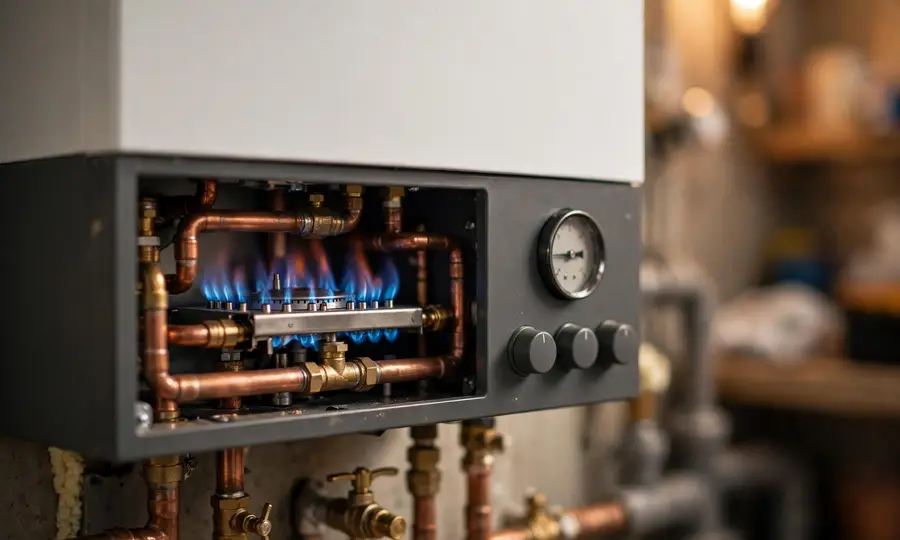
  • Yellow or orange flame (should be blue on gas) or soot marks around the boiler — incomplete combustion; shut down and call a professional.
  • Scorch marks or melting on or near the casing — shut down immediately.

Less dramatic but still telling: energy bills climbing with no change in usage (efficiency slipping), repairs stacking up year after year on an aging unit, and a boiler past 15–20 years that is becoming unreliable. At that point the honest question shifts from "what is wrong" to "repair or replace" — and a straight assessment beats another patch. If anything above sounds urgent, our emergency boiler repair page explains what counts as an emergency and what to do while you wait.

Warning-Sign FAQs

Quick answers to the questions homeowners ask most.

01

My radiators are cold at the top. Is the boiler broken?

Almost certainly not — cold tops mean trapped air. Bleed the affected radiators with a radiator key, then check and top up the boiler pressure to 12–15 psi. If it keeps happening, there may be a circulation issue drawing air in.

02

What does kettling sound like and is it serious?

Like a kettle rumbling or boiling — it is limescale on the heat exchanger restricting water flow, common in hard-water areas. It will not fix itself and slowly damages the exchanger; a descale or repair is needed.

03

My boiler keeps turning itself off. Should I keep resetting it?

No. Repeated lockouts mean a safety is stopping the boiler for a reason — failed ignition, overheating, pressure loss. Note the fault code and call for diagnosis instead of resetting again.

04

How do I know if it is time to replace rather than repair?

The honest markers: repair costs approaching a third of replacement on a 20+ year-old unit, frequent breakdowns, a weeping heat exchanger, or efficiency so low the fuel savings would cover a new boiler. An assessment with real numbers beats guessing.

05

Bills are up but the heating feels the same. Boiler problem?

Possibly — slipping efficiency, a scaled exchanger, or short cycling all burn extra fuel quietly. A service with combustion readings will show whether the boiler is the culprit or something else changed.

Need Boiler Repair Help?

Tell us what's happening with your heating system and where service is needed.

☎ Call (888) 766-1474Regular phone hours: 7 AM–7 PM  |  24/7 emergency telephone line
☎   Call (888) 766-1474