
What pressure should my boiler be at?
12 to 15 psi when the system is cold — roughly 0.8 to 1 bar. It will rise toward 20 to 25 psi when hot, which is normal. Below 12 psi is low; approaching 30 psi is high.
A homeowner-oriented explanation of boiler pressure, common symptoms, and when to seek assessment.
Bar or psi, cold or hot — what the needle is actually telling you.
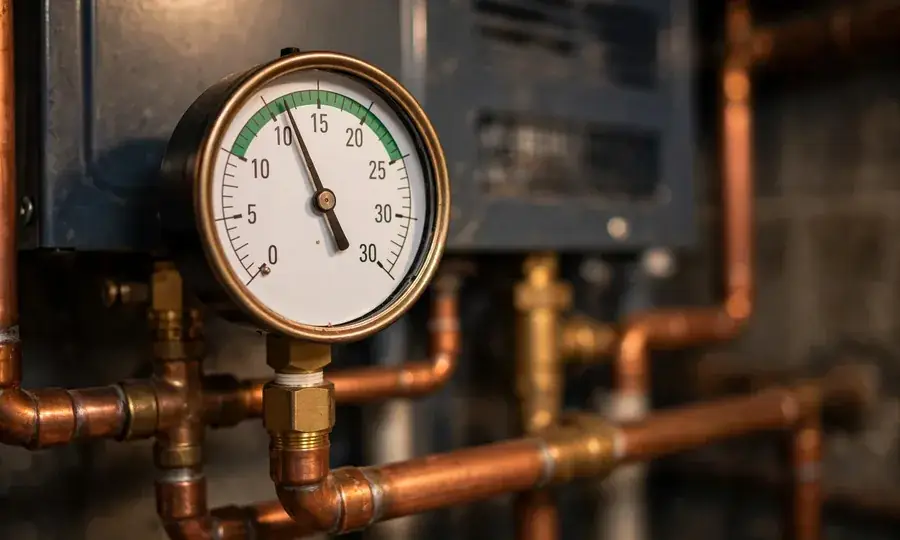
On a sealed heating system, the pressure gauge — usually a small round dial near the boiler, sometimes a digital readout — shows the pressure of the water inside the heating circuit. Most US gauges read in psi (pounds per square inch); some show bar as well. The conversion is simple: 1 bar is about 14.5 psi, so the normal 12 to 25 psi range is roughly 0.8 to 1.7 bar.
Always read the gauge when the system is cold for your baseline. Pressure rises as water heats and expands — a system at 15 psi cold may read 22 psi hot, and that is completely normal. Judging pressure on a hot system is the most common reason homeowners think something is wrong when nothing is.
Many gauges have colored zones: green (roughly 12–25 psi) is the operating range, with yellow or red zones below about 10 and above 30. If your gauge has no colors, remember the numbers: below 12 is low, 12 to 25 is normal, approaching 30 is high.
Where a healthy system lives, cold and hot.
A healthy sealed system sits at 12 to 15 psi when cold — the standard fill for a one- or two-story home (taller homes need more pressure to push water to the top floor). When the boiler fires and the water heats up, expansion pushes the needle up — typically toward 20 to 25 psi. That rise and fall with temperature is the system breathing normally.
Why does the number matter at all? The pressure is what pushes water to the highest radiator in the house. Too little pressure and the boiler's pressure switch refuses to fire — most modern boilers simply will not start below about 7 to 10 psi, which is why "boiler won't turn on" and "pressure at zero" so often arrive together. Too much pressure and the pressure-relief valve opens to dump water, usually through a copper pipe to outside.
The single most-discussed boiler topic online — and usually the simplest fix.
Low pressure is the most common pressure complaint, and social media is full of homeowners filming the same scene: a gauge needle sitting near zero and a boiler that will not fire. The causes, in order of likelihood:
How to top up: find the boiler's water feed — usually a small copper line with a shutoff valve, often with a bell-shaped pressure-reducing (auto-fill) valve on it. On a manual feed, open the valve slowly and watch the gauge climb; close it at 12 to 15 psi cold, then confirm the valve is fully closed. On an auto-fill valve, pressure should maintain itself — if the gauge keeps falling, the valve or another component needs attention. The whole job takes two minutes and is the fix behind thousands of "my boiler is fixed!" posts.
The warning that matters: topping up once after bleeding radiators is maintenance. Topping up every week is a symptom — usually a leak or a failed expansion tank — and endlessly adding fresh water accelerates internal corrosion. If the needle keeps falling, the system needs diagnosis, not more water. See our guide to boiler leaks and pressure faults.
Over 30 psi deserves respect — here is why and what to do.
High pressure is less common but more urgent. A gauge climbing toward or into the red (30 psi and above) usually means one of three things: the system was overfilled through the feed valve, the feed or auto-fill valve is letting water seep in on its own, or the expansion tank has failed so normal heat expansion has nowhere to go.
The safe homeowner fix is to bleed a radiator: with the system cool, open a bleed valve with a radiator key and a cloth, let out a little water, and watch the gauge fall back toward 15 psi. If pressure climbs right back up again — especially with the feed valve confirmed closed — the expansion tank or feed valve needs professional attention.
Never ignore a pressure-relief valve that keeps discharging water outside, and never cap or plug it. It is the system's last line of defense, and a valve that keeps opening is telling you the pressure problem is real and ongoing.
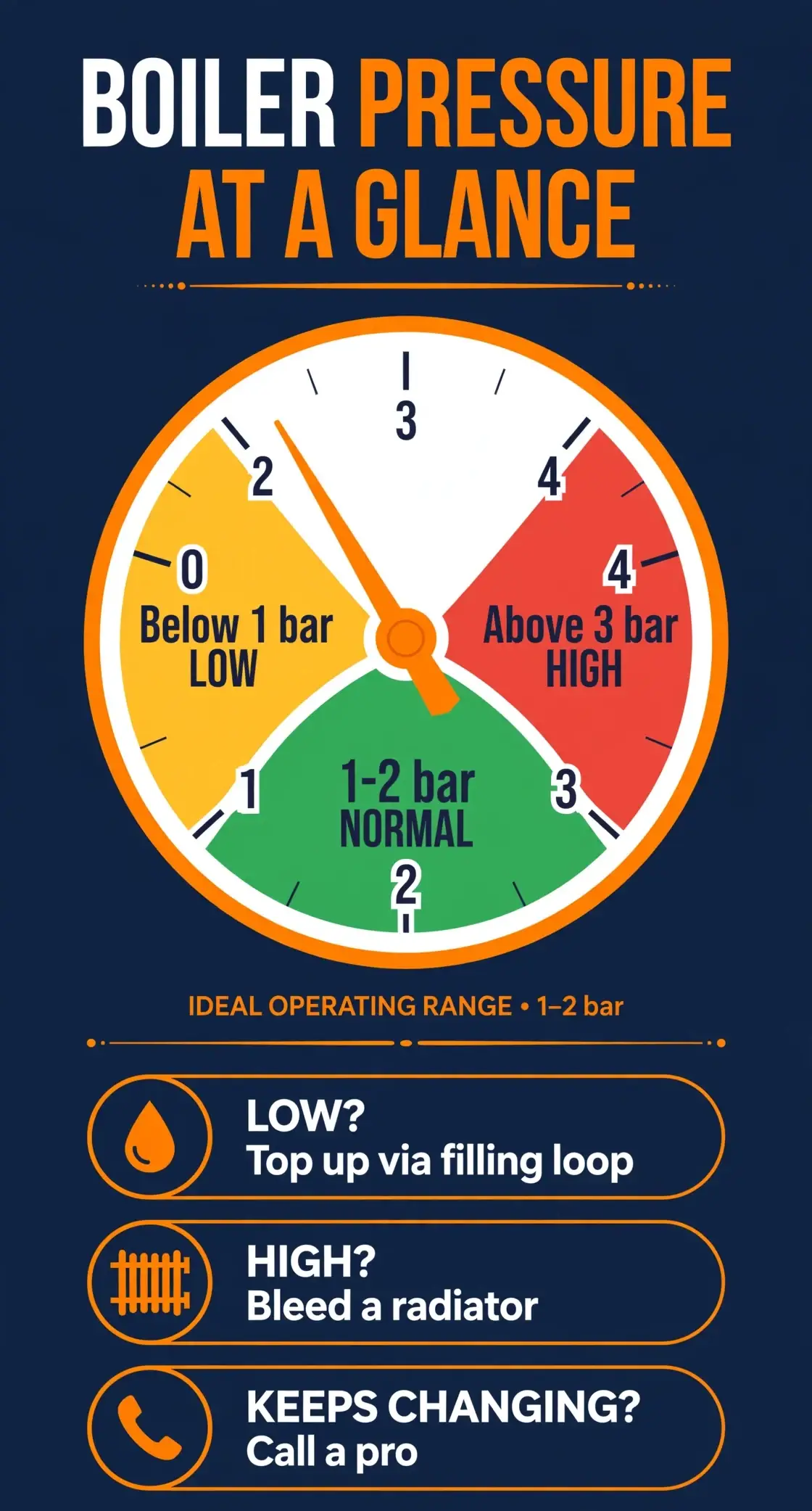
Boiler pressure at a glance — save or share this guide.
Patterns that mean it is time for a professional.
Some pressure behavior is a clear call-a-pro signal: the gauge drops to zero overnight and radiators are cold by morning, pressure spikes to 30 psi every time the heating runs, or you are topping up more than once a month with no visible leak. These point to expansion tank failure, a hidden leak under floors, or a faulty feed assembly — all diagnosable, none fixable by topping up harder.
A proper boiler service includes checking the expansion tank charge and the pressure-relief valve — the two components behind most chronic pressure stories. Catching a flat tank at service time is a small job; catching it after months of top-ups can mean a corroded system.
Quick answers to the questions homeowners ask most.
12 to 15 psi when the system is cold — roughly 0.8 to 1 bar. It will rise toward 20 to 25 psi when hot, which is normal. Below 12 psi is low; approaching 30 psi is high.
Yes — opening the feed valve slowly until the cold gauge reads 12 to 15 psi is standard homeowner maintenance. Just be sure to close the valve fully afterward, and do not make a habit of it: frequent top-ups mean a leak or failed component.
Usually a small leak (radiator valve, fitting, or relief pipe) or an expansion tank that has lost its air charge. If it happens repeatedly, the system needs a professional diagnosis rather than another top-up.
Sustained pressure above 30 psi will force the relief valve open and can strain components — that is what the valve is for. Reduce it by bleeding a radiator, and if it climbs straight back, call a professional. Never block or cap the relief valve.
Most modern boilers refuse to fire below about 7 to 10 psi as a safety measure. Top up via the feed valve to 12–15 psi cold and try again. If it fires, watch the gauge over the next few days; if it falls again, there is an underlying fault to find.
Tell us what's happening with your heating system and where service is needed.