
/>
ALLENTOWN GAS BOILER SERVICE

Gas Boiler Repair in Allentown, PA

Most of Allentown heats with gas — from coal-converted atmospheric units in center-city rowhouses to condensing wall-hungs in the townships. Gas boilers fail in a specific family of ways: ignition and flame sensing, venting and condensate, and water-side pressure. This page maps that fault family to Allentown's housing.

✓ Ignition & flame faults✓ Condensate & venting issues✓ a phone conversation about symptoms

General inquiries: 7 AM–7 PM · Emergency calls: 24/7 · (888) 766-1474

The gas fault family in Allentown

Ignition, flame, venting, condensate — in that order of frequency.

Gas boiler failures almost always trace to one of four subsystems. Ignition comes first: hot-surface igniters that crack with age, spark electrodes that erode, and standing-pilot thermocouples in the oldest converted units that simply wear out. Flame proving comes second: the flame sensor or flame-rod circuit that must confirm the flame exists, or the control shuts the gas valve as a safety measure — the classic "fires for ten seconds then quits" lockout on west-end colonials.

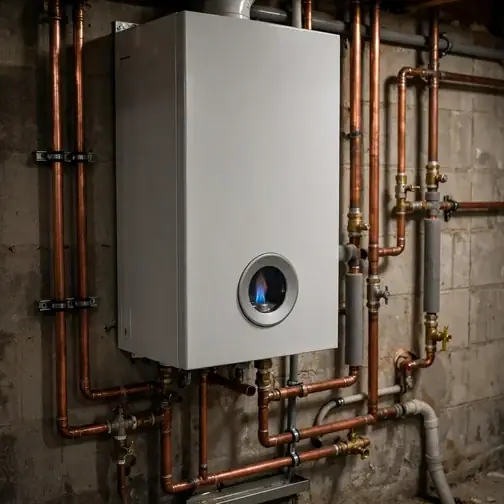
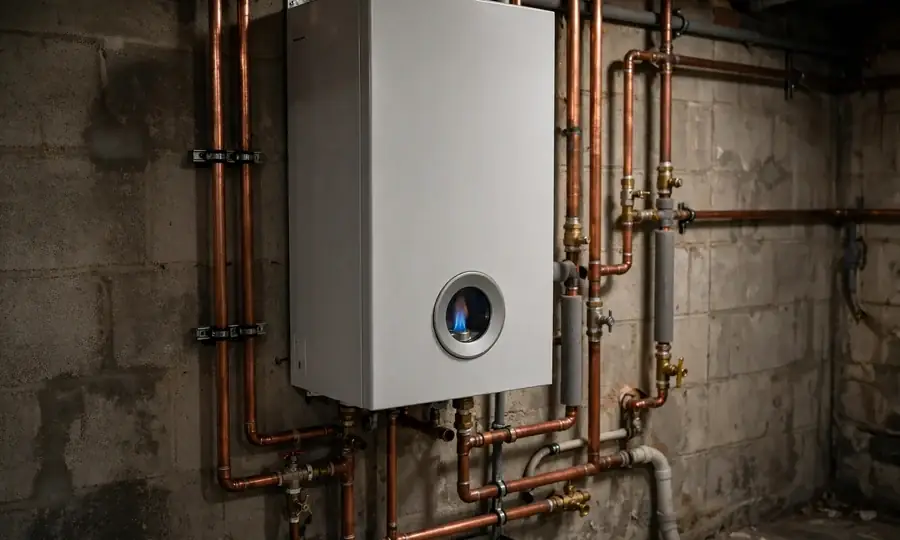
Modern gas boiler with copper piping in an Allentown basement

Venting and condensate round out the list. Atmospheric units in center-city basements draft through old masonry chimneys that can deteriorate or backdraft on windy nights. Condensing units — common in South Whitehall and Salisbury subdivisions — trade the chimney for a plastic vent and a condensate drain, and that drain is Allentown's single most weather-sensitive boiler component: run it outside without protection and single-digit nights freeze it, lock out the boiler, and create a no-heat call that a proper drain reroute prevents permanently.

Atmospheric vs. condensing: know which you have

Your fault family follows your boiler type.

  • Atmospheric (standing draft) gas — center-city rowhouses and older twins; metal vent or masonry chimney; faults center on ignition, thermocouples, and draft/venting issues
  • Induced-draft / power-vent gas — 80s–90s west-end and township installs; faults include pressure-switch and inducer-motor failures on top of the ignition chain
  • Condensing gas — newer township subdivisions; high-efficiency but adds the condensate drain, condensate pump, and plastic venting as failure points
  • Coal-converted atmospheric — the oldest center-city units; oversized cast-iron blocks with gas burners added later; faults include oversized short-cycling and deteriorated refractory
Gas Boiler Repair in Allentown, PA

The water side matters on gas too

Half of "gas problems" are water problems.

A gas burner that fires perfectly will still short-cycle, lock out on high limit, or bang if the water side is wrong. Low system pressure on a sealed west-end system — below the healthy 12–15 psi cold reading — points at the expansion tank or the auto-fill valve, not the burner. Air trapped in a center-city radiator circuit causes kettling that sounds like a burner fault but isn't. This is why the triage asks about the pressure gauge and cold rooms, not just whether the burner fires: on gas, the water side is half the diagnosis.

If your unit loses pressure between visits, read the boiler pressure guide before calling — knowing your cold reading and how fast it drops tells the triage which half of the system is suspect.

Gas Boiler Repair in Allentown, PA

Gas safety: the non-negotiable part

When the call is not to us.

A gas odor, a yellow or lazy burner flame on an atmospheric unit, or soot on the boiler jacket are not "watch and wait" symptoms. Smell gas: leave the building, call the utility's emergency line or 911 from outside, and do not flip switches or light anything. Soot or a yellow flame: shut the unit down if you can do so safely and call the 24/7 line — those are combustion problems, and combustion problems get priority.

Carbon monoxide alarms belong in the hallway outside any room with a fuel-burning appliance. If yours sounds, treat it like a gas odor: out first, utility second, boiler questions after.

Gas Boiler Repair in Allentown, PA

Frequently Asked Questions

Straight answers before you call.

01

My gas boiler will not fire. What does the technician check first?

The ignition train: igniter, flame sensor, gas valve, and the safety circuit that proves flame before the main valve opens. On older atmospheric units in center-city conversions, worn flame sensors and tired thermocouples are the usual suspects. On sealed west-end systems, pressure switches and venting join the checklist.

02

What does a lockout code on the display actually mean?

It is the boiler telling you which safety tripped: flame failure, low water pressure, a blocked vent, or an overheating limit. Write the code down exactly as shown before you touch anything, because clearing it erases the only clue. Then call (888) 766-1474 and read the code off on the triage call.

03

Our center-city unit still runs a standing pilot. Is that a problem?

Standing-pilot atmospheric boilers are the oldest gas generation in Allentown's center-city stock, and they fail at the pilot assembly and thermocouple first. A pilot that will not stay lit usually means a worn thermocouple, a dirty pilot orifice, or a failing gas valve. They are serviceable, but each outage is a nudge toward planning a replacement.

04

Why does my township unit's condensate line freeze every January?

Condensing gas boilers make acidic condensate that has to drain somewhere, and externally run lines freeze solid on January nights in the teens across the Lehigh Valley. The fix is routing the drain inside or insulating the run. If yours ices over, mention it on the call so the visit plans the reroute.

05

The boiler fires fine but the house will not warm up. Is the gas side at fault?

Probably not. A boiler that fires and stays lit is doing its combustion job, so the fault is downstream: air-bound radiators, a stuck zone valve, a failing circulator, or loops that were never balanced for the house. West-end colonials with original piping are classic for this. Describe which rooms are cold and the triage will route it right.

Allentown gas boiler services

Related services for gas-heated homes.

Nationally, gas boiler repair covers the ignition, flame-proving, and condensate fault family in general terms. For the full symptom picture, the Allentown diagnosis and repair page maps symptoms to causes across fuels, and a dead unit on a freezing night belongs on the emergency page. When the gas unit itself is finished, installation and replacement walks through sizing and fuel choice — including whether staying on gas is the right call for your block. Learn how the service works before you book.

Gas boiler acting up in Allentown?

Call (888) 766-1474 — describe the symptom and get connected to a local pro.

☎   Call (888) 766-1474