/>
ALLENTOWN BOILER INSTALLATION

Boiler Installation & Replacement in Allentown, PA

A boiler is done when the block itself is done — not when a salesperson says so. This page is the honest replacement framework for Allentown: the signals that mean replace, how sizing works across rowhouses and colonials, and the gas-versus-oil fuel question that defines this city.

✓ Repair-vs-replace signals✓ Heat-loss sizing math✓ a phone conversation about symptoms

General inquiries: 7 AM–7 PM · Emergency calls: 24/7 · (888) 766-1474

Replacement signals: the block gives the verdict

Repair the parts; replace the block.

Controls, sensors, igniters, nozzles, and circulators are parts — they wear out and get replaced, and none of them ends a boiler's life. What ends a boiler's life is the cast-iron block itself: sections that weep water at the push nipples, visible cracks in the heat exchanger, or sections that have been pinned and sealed and are weeping again. A block that can't hold water or combustion gases is finished, and no repair changes that.

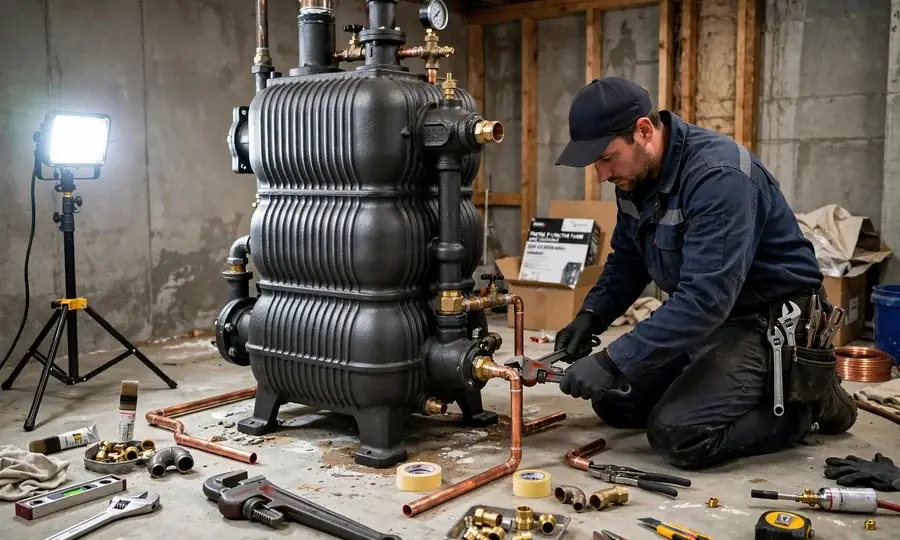
New boiler being installed in an Allentown home basement

The softer signals matter too: a burner that needs attention every season despite proper service, efficiency so degraded that fuel bills climb while comfort doesn't, and parts the supply houses no longer stock. If your unit has two of these, start planning — because a planned replacement in October costs less stress (and usually less money) than an emergency swap in January. And if you're still on the fence, Allentown boiler diagnosis and repair can tell you honestly which side of the line your unit is on.

Sizing: the math that protects you

Heat-loss calculation, not rule of thumb.

The correct boiler size comes from a heat-loss calculation on your home: square footage, insulation levels, window area and quality, air leakage, and design temperature for the Lehigh Valley. It does not come from the size of the unit being replaced — Allentown's older stock is full of legacy units that were oversized when fuel was cheap and coal was the reference fuel. A center-city twin heated fine for decades by a 150,000-BTU dinosaur may only need 70,000 BTU today after windows and insulation upgrades.

Oversizing is the quietest expensive mistake in heating: a boiler that short-cycles from day one burns more fuel, wears faster, and never reaches steady efficiency. The right question for any installer is "show me the heat-loss numbers" — if they sized it by square footage alone, keep shopping.

Boiler Installation & Replacement in Allentown, PA

Fuel choice: the Allentown question

Gas where it runs; oil where it doesn't.

Every Allentown replacement eventually hits the fuel question, because this city genuinely has both. Staying on your current fuel is usually the cheapest path: same venting family, same fuel infrastructure, no line or meter costs. Switching oil to gas makes sense when gas reaches your block and the line cost is reasonable — confirm availability with the utility before believing any quote, because the pockets without gas are real and a gas boiler without a gas line is an expensive sculpture.

Two notes the sales pitches skip: first, venting — a modern unit may need different venting than the old one, and center-city rowhouses with shared masonry chimneys need that planned, not discovered mid-install. Second, steam stays steam unless you're rebuilding the distribution: converting a one-pipe steam center-city home to hot water is a real project. The steam vs. hot-water boilers guide walks through that decision honestly.

Boiler Installation & Replacement in Allentown, PA

What a replacement visit involves

Measurements, not guesses.

  • Heat-loss calculation — room-by-room measurement and the real BTU number for your home
  • Venting assessment — chimney condition on center-city homes, or vent routing for condensing units
  • Fuel verification — gas line availability and capacity, or oil tank condition and location
  • Distribution review — radiators, baseboard, or radiant sized for the new unit's water temperatures
  • Pressure-side setup — expansion tank sizing and auto-fill valve for a sealed system that holds 12–15 psi cold
  • Removal logistics — old cast-iron sections come out in pieces; narrow center-city stairs are planned for, not surprised by

Frequently Asked Questions

Straight answers before you call.

01

When should I replace my Allentown boiler instead of repairing it?

When the block itself is done: weeping sections on cast-iron, a cracked heat exchanger, or a burner rebuilt twice on a thirty-year-old unit. Rising fuel bills with repeated breakdowns are the other tell. Center-city conversions and old oil blocks hit this wall most often, and the replacement page walks through the math.

02

Can I switch from oil to gas in the townships?

Only where the gas mains reach your street, and that is genuinely street-by-street in South Whitehall and Upper Macungie. A gas conversion also means new venting, gas piping, and sometimes chimney work for the old oil flue. Call (888) 766-1474 with your ZIP and street, and the triage can tell you what is realistic before you plan around it.

03

How do you size a boiler for a 1920s colonial with cast-iron radiators?

By heat-loss calculation for the house, not by copying the old unit's rating, because coal-era and early gas blocks were routinely oversized by half. The existing radiators set the water-temperature ceiling, which decides whether a condensing unit makes sense. Oversizing is the classic Allentown mistake: it short-cycles and wastes fuel for decades.

04

What makes installation harder in a center-city rowhouse?

Access. Narrow basement stairs, low headroom, street parking for the truck, and a century of layered piping that has to be sorted before the new unit drops in. The old block often has to come out in pieces. Describe the basement access on the call so the job is planned around it, not discovered on arrival.

05

Should a converted coal-to-gas unit be replaced with the same kind of boiler?

Not necessarily. The conversion burner was a compromise from another era; a modern sealed gas boiler is sized to the house, vents properly, and runs at steady efficiency. If the house still has one-pipe steam, though, the replacement has to stay steam. The fuel and the distribution system decide, not the old nameplate.

Allentown boiler installation services

Related services for the replacement decision.

If you're weighing whether the current unit has life left, Allentown boiler diagnosis and repair gives you the honest verdict first, and signs your boiler needs repair covers the early warnings in general terms. For the hot-water majority of replacements, hot-water hydronic boiler repair explains the sealed systems the new unit will run on, and the boiler pressure guide covers what a healthy new system looks like at 12–15 psi cold. Learn how the service works before you book.

Boiler done in Allentown?

Call (888) 766-1474 — talk through repair vs. replacement with a local pro.

☎   Call (888) 766-1474