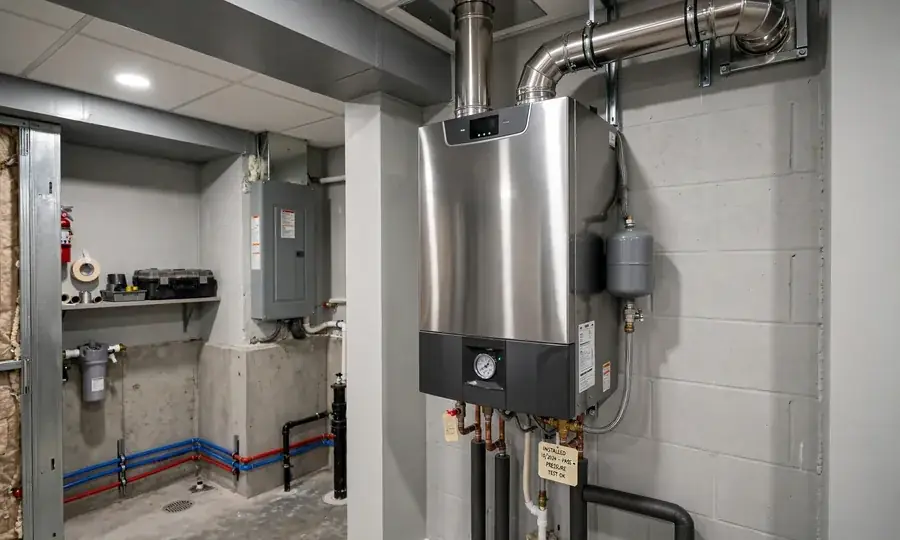
Arlington colonials have spent decades getting tighter — new windows, added insulation, sealed gaps — and that is good for fuel bills but quietly bad for atmospheric gas boilers. Those boilers breathe room air for combustion. In a leaky 1950s envelope, air arrived through every crack; in a renovated, air-sealed home, the boiler can starve. A starved burner runs lazy and yellow instead of crisp and blue, produces soot, trips spill switches, and raises carbon monoxide risk — the fault that turns up as mysterious lockouts or a CO alarm with no obvious cause.
The warning signs are visible: soot marks around the boiler casing or flue pipe, a flame that looks lazy rather than sharp, or a boiler-room door that must stay open “or else.” The fix is dedicated combustion air — a louvered door or a ducted outdoor intake, sized to the boiler — scoped by the tech, not improvised. Tight homes also backdraft more easily: a kitchen or bath exhaust fan can pull flue gases backward down the chimney when the boiler is starved for air. Any replacement quote for an atmospheric unit in a tightened colonial should address combustion air explicitly. And soot is never cosmetic: if you see it, shut the boiler down and call. A boiler that cannot breathe cannot burn cleanly.