
/>
NEW HAVEN GAS SERVICE

Gas Boiler Repair in New Haven, CT

Flame sensors foul, igniters crack, gas valves stick, and the boiler locks out on the coldest night of the year. Add coastal wind and January condensate freezes, and gas here has its own failure calendar. Note the fault code, describe the flame behavior, and get triage from people who read gas boilers for a living.

✓ Ignition & flame-sensing faults✓ Condensate & venting fixes✓ CO safety checks

General inquiries: 7 AM–7 PM · Emergency calls: 24/7 · (888) 766-1474

Gas in New Haven context

The dominant fuel — across three housing types.

Gas spans New Haven's whole range: colonials and Tudors in East Rock, Prospect Hill, and Westville with conventional gas boilers — many converted from oil or coal decades ago, atmospheric units with standing pilots or early electronic ignition; downtown and the Green with apartment buildings on central gas plants; and newer construction and gut renovations with sealed, condensing wall-hung units. The fault tree splits by generation: an atmospheric conversion and a condensing unit share a fuel and almost nothing else.

The oil boiler page covers the other fuel in full. Related information: oil boiler page.

Gas Boiler Repair in New Haven, CT

Ignition, flame, and control faults

Where gas boilers actually fail.

  • Flame-sensor fouling — the sensor can't prove flame, the control locks out; a cleaning fixes what a new board won't
  • Cracked hot-surface igniters — glow, don't light; classic on aging atmospheric conversions
  • Stuck or slow gas valves — delayed ignition, rumbling starts, lockouts on the coldest nights
  • Failed thermocouples and pilot assemblies — standing-pilot units that won't stay lit
  • Condensate trap and drain blockages — condensing units that shut down on their own safety switches
  • Pressure and expansion faults — sealed systems losing 12–15 psi cold readings from tired expansion tanks
  • Control and sensor drift — outdoor-reset and aquastat faults that waste gas without stopping heat
Gas Boiler Repair in New Haven, CT

Condensate, venting, and coastal wind

New Haven's gas-specific weather problems.

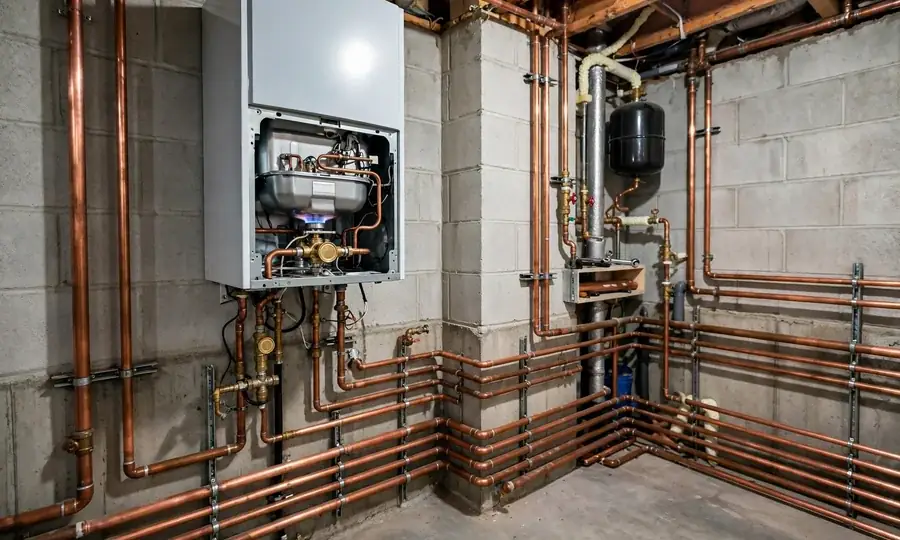
Gas boiler with extensive baseboard heating pipes in a New Haven, Connecticut home basement

Two weather problems hunt New Haven gas boilers every winter. First, condensate freeze: condensing units produce acidic condensate that must drain somewhere, and drains routed outside or through unheated spaces freeze solid on January nights — the boiler's own safety switch shuts it down, which looks exactly like a dead boiler. Second, wind on sidewall venting: gusts off the Sound create pressure fluctuations at direct-vent terminations, and some units lock out in high wind. If your lockouts cluster on windy nights, say so — it changes the diagnosis.

Both are fixable at the system level — condensate rerouted to a heated drain, vent terminations relocated or shielded — rather than at the boiler. A gas visit that only clears the fault code and leaves the drain outside has not finished the job. The national gas boiler repair guide covers these fault families in general terms, and the pressure guide explains the 12–15 psi cold baseline your sealed system should hold.

Safety: gas odor and CO

Two rules, no exceptions.

If you smell gas — rotten-egg odor — near the boiler, leave the building and call the gas utility or 911 from outside. Do not flip switches, do not reset the boiler, do not go back in to "check." Only after the utility has cleared the building does a repair visit make sense.

Carbon monoxide is the quieter risk: a cracked heat exchanger or a blocked vent can spill CO into the living space. Working CO alarms on every floor are non-negotiable in a gas-heated home, and any alarm event means fresh air, out of the building, and a call — the boiler stays off until it has been checked. A dead unit after a gas incident belongs on the emergency page once cleared.

Gas Boiler Repair in New Haven, CT

New Haven gas boiler services

Related services in the New Haven area.

The national gas boiler repair service page covers gas fault families in general terms. For New Haven-specific angles, the diagnosis page handles symptoms that cross fuel lines, and the emergency page covers gas incidents once the utility has cleared them. Heating with oil instead? The oil boiler page is the other fuel's home. When the unit is done, the replacement page walks through fuel choice.

Frequently Asked Questions

Straight answers before you call.

01

My Westville converted atmospheric boiler keeps locking out. What is the usual cause?

Flame sensor and igniter wear — the classic failure on older atmospheric conversions that have been running for decades. They soot up, weaken, and start dropping the flame signal intermittently. If cleaning no longer holds, the sensor needs replacement; describe the lockout pattern when you call (888) 766-1474.

02

High wind keeps shutting my boiler down. What is the actual fix?

Re-terminating or re-screening the sidewall vent so gusts cannot fight the draft — the lockout is the boiler protecting itself, not a broken part. A technician evaluates the termination location, height, and exposure, then corrects it. Mention the wind correlation on the call; it changes the visit from a parts swap to a venting job.

03

My downtown condo is on a shared boiler plant. Who do I call for heat problems?

Your building management or HOA — an individual owner cannot authorize work on a central plant, and the triage will refer you there. If your unit has its own boiler, that is yours to service like any single-family system. Sort out which one you have before calling.

04

The condensate pump on my high-efficiency unit runs constantly. Problem?

Possibly — a pump that never stops may be fighting a blocked or frozen drain, or its float switch is failing. Check whether water is actually discharging outside; if the pump runs dry or the pit overflows, shut the unit down and call. Condensate backups shut modern boilers down as designed.

05

Should I replace my old atmospheric boiler with a sealed-combustion unit?

Sealed combustion resists wind-related shutdowns and is more efficient — real advantages on the New Haven coast. But it needs a proper venting plan, especially in older colonials with masonry chimneys. An on-site assessment of the venting path decides whether the upgrade is straightforward or a project.

Gas boiler acting up in New Haven?

Call (888) 766-1474 — describe the fault code or symptom and get connected to a local pro.

☎   Call (888) 766-1474