/>
ELIZABETHTOWN BOILER INSTALLATION

Boiler Installation & Replacement in Elizabethtown, PA

Every boiler reaches a point where repair stops being the smart money — the question is recognizing it before a January failure makes the decision for you. In Elizabethtown, that decision runs through the local housing stock: converted downtown units with tired blocks, township-edge oil systems far from gas mains, and post-war homes where the distribution system outlasts the boiler. This page covers the replacement signals, sizing discipline, and fuel-choice math for this town.

✓ Replacement signals✓ Sizing for local housing✓ Oil vs. gas fuel choice

General inquiries: 7 AM–7 PM · Emergency calls: 24/7 · (888) 766-1474

Signals the boiler is done

Repair stops being the smart money when these appear.

Section weeps or cracks in a cast-iron block are the hard stop — a weeping section cannot be repaired reliably, and water loss will only accelerate. Beyond that, watch for the pattern signals: a burner that needs constant attention (season after season of nozzle, electrode, and control work on oil; repeated ignition parts on gas), efficiency stuck low while fuel bills climb, parts that are no longer available for your specific model, and repeated no-heat calls in a single winter.

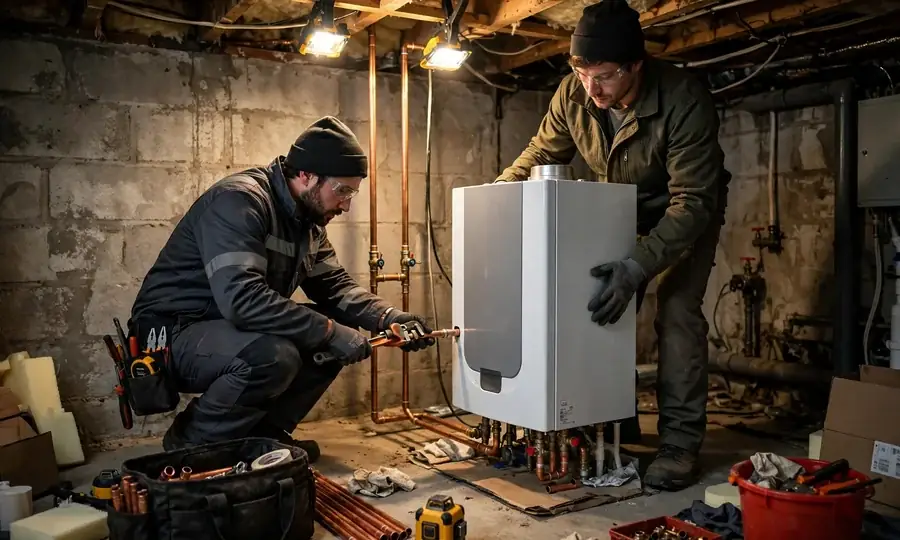
Two technicians installing a new residential boiler in a basement

Age alone is not the verdict — plenty of 30-year blocks heat fine with maintained burners — but age plus two or more of these signals is. If you are unsure, a diagnosis visit can separate “tired controls on a sound block” (repair) from “dead block with good controls” (replace). The repair page explains what that visit involves.

Sizing for Elizabethtown housing

The most common installation mistake is oversizing.

An oversized boiler short-cycles itself to an early grave — and Elizabethtown’s housing makes oversizing easy to get wrong in both directions. Downtown rowhouses and twins share walls, which cuts heat loss, but they also leak air through old windows and uninsulated basements; the right size is smaller than the ancient coal-era unit it replaces, but not a guess. Post-war capes and ranches need a proper heat-loss calculation against their actual insulation and window stock, not the old boiler’s nameplate.

Sizing must also respect the distribution: existing baseboard or radiators can only emit so much heat, so a bigger boiler on the same emitters buys nothing. On one-pipe steam systems downtown, sizing follows the connected radiation (EDR), never the building’s square footage — and converting steam to hot water is a re-piping decision, not just a boiler swap.

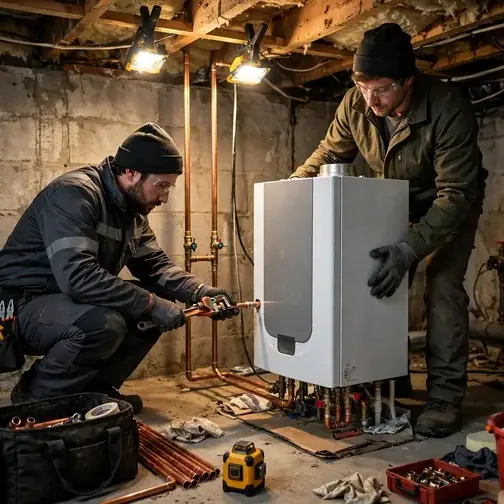
Boiler Installation in Elizabethtown, PA

Fuel choice: stay or switch

The honest math for a mixed-fuel town.

Staying on oil is often the right call on the Mount Joy Township edges — where gas mains do not reach, a modern oil boiler with an efficient burner is the practical answer, and the existing tank and lines are already paid for. Staying on gas is the default downtown and in the post-war ring, where the gas infrastructure already serves the house.

Switching fuels deserves a hard look at the full cost: oil-to-gas means a gas service run, meter, and piping — worthwhile only where the main is close and the long-term fuel math favors it. Propane on the township edges is the third option, usually for homes already on propane or where oil delivery is impractical. The decision should weigh fuel availability, venting requirements, and the condition of your distribution system — not marketing. A call can talk through what your specific property actually allows.

Boiler Installation in Elizabethtown, PA

What an installation involves

More than swapping a box.

A proper replacement starts with the old unit coming out down the same narrow basement stairs it went down decades ago — downtown access planning is real work. Then: piping adapted to the new unit’s connections, venting brought to current requirements (chimney liner for atmospheric units, sealed venting for condensing), controls including outdoor reset where it pays, and the system cleaned and refilled so the new boiler does not inherit the old water’s sludge.

Expect the water side to be addressed too: expansion tank sizing, auto-fill valve function, and air elimination — the unglamorous parts that determine whether the new boiler runs at its rated efficiency. Ask what is included beyond the boiler itself before authorizing anything.

Boiler Installation in Elizabethtown, PA

Frequently Asked Questions

Straight answers before you call.

01

My downtown boiler is 35 years old. When do I stop repairing it?

When the block itself is going: weeping sections, a cracked exchanger, or a burner that has been rebuilt more than once. At 35, every repair buys less time, and the unit will pick the coldest night to quit for good. A planned replacement gets you right-sizing and a heat-loss calculation; an emergency one gets you whatever is available.

02

Can I switch my township-edge home from oil to propane?

Sometimes, and it is worth pricing: propane needs a tank set and new gas piping, and the fuel logistics change from oil delivery to propane delivery. The boiler choice changes too, since propane units are gas units with different orifices and setup. Call (888) 766-1474 to talk through what fits the property; the lot and the existing distribution decide.

03

How is a replacement sized for a twin with original radiators?

By heat loss, not by the old nameplate: coal-era blocks were massively oversized, and the radiators are the real constraint. Original radiators are usually generous, which is good news for efficiency. The calculation lands the unit size; the radiator survey confirms the water temperatures it can run.

04

What complicates installation in a downtown rowhouse basement?

Low headroom, narrow stairs, and a century of layered piping in a basement that was built for coal, not contractors. The old block leaves in pieces and the new near-boiler piping has to adapt to what is there. A site visit beforehand is essential; the basement always holds one surprise.

05

Should I do the oil tank and the boiler in one project?

If the tank is old, absolutely. The crew, the piping, and the mess are already there, and a new boiler on a dying tank is a leak waiting for a date. Bundling them also means one commissioning, one disruption, and no second round of basement archaeology next year.

Replacement resources

National guides for the replacement decision.

For the general replacement framework, see signs your boiler needs repair — many of the same signals mark the repair/replace boundary — and steam vs. hot-water boilers if your downtown system runs steam. Fuel-specific detail lives on the gas page and the oil page. Our how it works page explains the connection process, and the Pennsylvania hub covers the broader state market.

Replacing a boiler in Elizabethtown?

Call (888) 766-1474 — talk through the signals, the sizing, and the fuel choice with a local pro.

☎   Call (888) 766-1474