
/>
JAMAICA OIL BOILER SERVICE

Oil Boiler Repair in Jamaica, NY

Oil heat in Jamaica is a holdout story. When gas mains spread through Queens, most buildings converted — but the larger singles toward Jamaica Estates and scattered pockets elsewhere kept their oil boilers, and about one home in nine still runs on oil today. Those systems are 25 to 40 years old now: cast-iron blocks, gun burners, basement tanks. This page is for the holdouts — why the oil stayed, how to run it reliably, and what fails.

✓ The eleven-percent holdouts✓ Tanks, burners & deliveries✓ a phone conversation about symptoms · (888) 766-1474

General inquiries: 7 AM–7 PM · Emergency calls: 24/7 · (888) 766-1474

Why oil stayed in Jamaica Estates

The holdout story.

Conversions cost money, and working equipment is a persuasive argument for doing nothing. The big singles toward Jamaica Estates heated fine on oil; the tanks were solid; the boilers had decades left. So when gas service arrived, many owners did the math and kept the oil — and then kept it for another twenty years. Scattered holdout blocks elsewhere in Jamaica followed the same logic: multifamily conversions whose economics never worked, blocks the mains reached late.

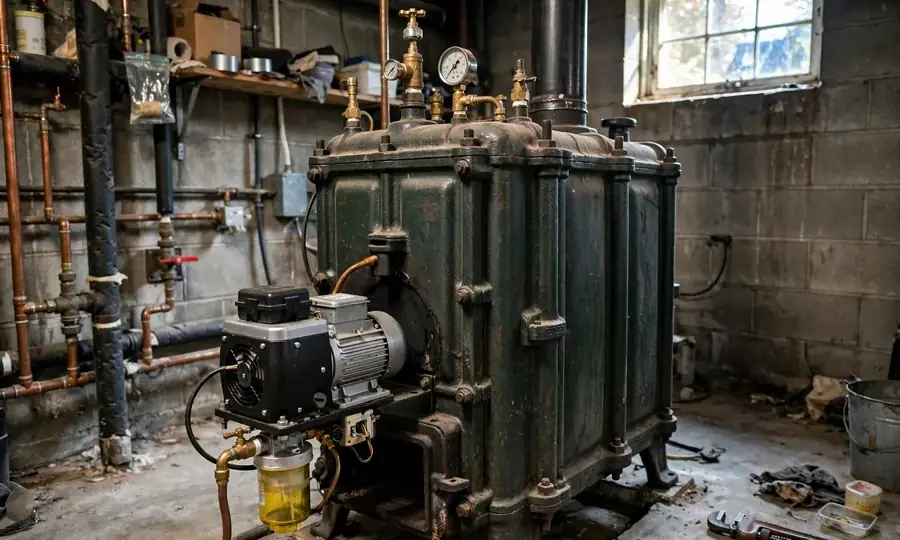
The result is a neighborhood-within-the-neighborhood of 25- to 40-year-old oil plants: cast-iron boilers, gun burners, 275-gallon basement tanks, copper lines with the patina of decades. The service reality follows the fuel: burner, tank, filter, and fuel-drop schedule matter as much as the boiler itself, and the triage treats oil calls as fuel-logistics calls first.

Oil Boiler Repair in Jamaica, NY

Running oil reliably: the calendar

Oil heat is a scheduling discipline.

Reorder before you’re low. Watching the gauge through December and ordering with a real margin beats every alternative — run-outs in cold snaps are how the worst oil nights start, and a dry tank drags sludge into the filter and nozzle on its way down.

Service before the season. One pre-season visit — nozzle, filter, electrodes, combustion check — before the cold months. Oil is a dirtier fuel than gas and the burner is a precision instrument; skipping the service is the most reliable way to manufacture a deep-winter failure.

Expect filter trouble after fuel drops. Incoming oil stirs years of tank sediment, and the days after a fuel drop are peak season for starved-burner calls. If the burner acts up within a week of a fuel drop, say so on the triage call — it’s a strong clue, and the fix is usually a filter.

Oil Boiler Repair in Jamaica, NY

The fuel’s journey to the flame

Follow the oil; find the fault.

Every bit of heat in an oil home travels the same route: tank to fuel line, through the filter, into the fuel pump, out the atomizer as a fine mist, met by the spark. A failure anywhere on that route reads as “the burner won’t fire” — but the fix depends on where the journey breaks down, which is why the visit traces the route instead of guessing at the burner.

The usual break points: the filter choked with residue (especially in the days after a fuel drop stirs the tank); the atomizer fouled or worn so the mist collapses; the spark assembly eroded and drifted, giving intermittent spark and delayed ignition with its startling puffback; the fuel pump worn out, spinning with nothing to push. The visit works the route in order — tank and fuel level, filter, burner assembly, then a watched test cycle confirming a clean, even burn — and reports back as a clear account: where the journey failed, and why, and what’s drifting toward the same fate.

Oil Boiler Repair in Jamaica, NY

The tank’s biography

Thirty years of quiet service, then the signs.

A basement oil tank doesn’t fail all at once — it retires gradually, and it announces the retirement. Seams begin to seep. Corrosion streaks down the sides. An oil odor appears where last cold season had none. The pro reads these signs on every visit, because funds spent rebuilding a burner above a dying tank are funds misaimed.

The level deserves its own skepticism. Mechanical level gauges stick with age — a needle parked at a quarter on a seized float has ended many cold nights. When the burner won’t fire, the triage runs a fuel-level verification before anything else: the least expensive fix in oil heat, and the most commonly skipped.

Oil Boiler Repair in Jamaica, NY

The conversion question

Oil to gas, at the right moment.

Every Jamaica Estates oil owner eventually prices the switch. The case for converting: gas service reaches the curb, the boiler is near end of life, and one project replaces both the burner’s future and the tank’s. The case for staying: a solid tank, a boiler with years left, and a gas main that’s two blocks away — main extensions cost real money, and ripping out working equipment to chase fashion rarely pays.

The honest way to decide is a side-by-side the evaluation can produce: conversion cost (including any main extension and the tank’s removal) against the remaining life of the oil plant and the fuel-price difference over that span. No guesswork — just your house’s numbers. The replacement page has the framework; the triage talk-through is free.

Oil Boiler Repair in Jamaica, NY

Oil heat questions

Straight answers for the holdouts.

01

My Jamaica walk-up still heats with oil and the burner locks out on the coldest mornings. Why mornings?

Cold oil is thicker oil, and the first firing of the day is when a weak burner shows it: worn nozzle, electrodes out of adjustment, tired ignition. If the tank or fuel line runs through a cold basement or exterior wall, the effect is stronger. A burner service with nozzle, filter, and combustion check usually ends the morning lockout routine. Call (888) 766-1474 before the next cold snap.

02

How do I know if my Jamaica oil tank gauge is lying to me?

If the reading never changes between deliveries, the float is probably stuck. Tap the gauge lightly; a working float moves, and compare the gauge against delivery tickets over the season. A stuck gauge causes more run-dry calls than empty tanks do. Mention a suspect gauge when you call (888) 766-1474, because it changes the service plan.

03

We ran dry last winter and now the burner soots up constantly. Related?

Directly. Running dry pulls sludge off the tank bottom into the filter, nozzle, and pump, and a partially clogged nozzle sprays a bad pattern that soots the heat exchanger. The fix is a filter and nozzle change plus brushing the sooted surfaces and a combustion check. Tell the triage at (888) 766-1474 about the run-dry history.

04

There is an oil smell around my Jamaica basement tank but I cannot find a leak. What is it?

Start with the filter housing, the fuel-line fittings, and the tank gauge opening; weeping connections evaporate before they form drips. A burner running rich can also push odor out through the draft controls. If the smell is strong near the tank seams, get a professional look promptly rather than waiting. Call (888) 766-1474 and say where the smell concentrates.

05

My oil boiler is 30 years old and still runs. Does it need anything special?

At 30, it needs faithful annual service more than anything: nozzle, filter, strainer, electrodes, and a combustion check every year without fail. Watch for weeping sections, a rusting flue pipe, and parts getting hard to find. The service visit is also when a technician can tell you honestly how many seasons the old unit likely has left.

Oil boiler help for Jamaica and nearby

Where to go next.

Beyond the burner and tank — distribution, controls, pressure — boiler repair in Jamaica handles the whole diagnostic work. The national oil boiler repair page goes further on burner internals and firing, and signs your boiler may need repair helps you read the symptoms before you call. Oil’s footprint is heavier east of Jamaica: Elmont and Valley Stream show the oil-heavy side of Queens and Nassau, where the same tanks-and-fuel-drops reality runs even larger.

Oil burner trouble in Jamaica?

Call (888) 766-1474 — mention your fuel and tank level on the call.

☎   Call (888) 766-1474